 NeuroAds
What Is an AI Chatbot Platform? The Complete Guide for Ecommerce Brands
An AI chatbot platform is software that enables businesses to create intelligent, automated conversations with customers using artificial intelligence. For ecommerce brands, it can turn a passive storefront into an interactive shopping experience.
Unlike traditional chatbots that depend heavily on predefined scripts and rigid decision trees, modern AI chatbot platforms can understand natural-language questions, identify customer intent, generate relevant responses, recommend products, capture leads, assist shoppers, and guide customers throughout the buying journey.
Think about what happens when someone walks into a physical store. They can ask which product is right for them, whether an item comes in their size, how two products differ, when an order will arrive, or whether a purchase can be returned. A salesperson can answer those questions immediately.
Online, customers often have to search through product pages, menus, FAQs, shipping policies, and support pages to find an answer. Some will search. Others will leave.
An AI chatbot can change that experience by bringing relevant information directly to the customer through conversation. That is why AI chatbots are becoming much more than customer-support tools. For ecommerce brands, conversational AI can become part of the sales, conversion, lead-generation, customer-support, and retention infrastructure of the business.
How Does an AI Chatbot Platform Work?
At its simplest, an AI chatbot connects a customer’s question with the information and actions available within a business. When a visitor sends a message, the chatbot analyzes the request, determines what the visitor is trying to accomplish, identifies relevant information, and generates an appropriate response.
Modern AI chatbot platforms may use technologies such as natural language processing, large language models, product databases, knowledge bases, customer data, APIs, and ecommerce integrations to create these conversations. The result should feel less like navigating a menu and more like interacting with a knowledgeable digital assistant.
Imagine a shopper visiting an online skincare store and asking: “I have dry skin and want something lightweight for daytime. What should I use?” A traditional rules-based chatbot may struggle unless that specific question or workflow has already been programmed. An AI chatbot can potentially understand that the customer has dry skin, wants a daytime product, prefers a lightweight texture, and is asking for a recommendation.
The goal of an effective ecommerce chatbot isn’t simply to answer questions. It’s to help customers make better purchasing decisions.
AI Chatbot vs. Traditional Chatbot: What’s the Difference?
Not every chatbot is an AI chatbot. Traditional chatbots commonly operate through predefined rules and workflows. They may ask visitors to choose Shipping, Returns, Products, or Contact Support from a menu. These systems can be useful, but they force the customer to communicate according to the system’s structure.
AI chatbots allow customers to communicate more naturally. A shopper can ask, “I ordered yesterday but accidentally selected the wrong size. Can I change it before it ships?” An AI-powered system can potentially interpret the meaning of the entire request rather than requiring the customer to navigate through several menus.
The experience moves from Click → Menu → Menu → Search → Answer to Question → Answer → Action. For ecommerce businesses, removing unnecessary steps can reduce friction between customer interest and purchase.
Why Are AI Chatbots Important for Ecommerce?
Ecommerce has one major disadvantage compared with physical retail: there usually isn’t a salesperson standing beside the customer. Your website may have excellent photography, detailed product descriptions, videos, FAQs, reviews, and carefully designed landing pages. Customers will still have questions.
Those questions often appear when purchasing intent is highest. A shopper may be ready to buy but uncertain about sizing, compatibility, ingredients, shipping, returns, color, features, warranty, or product differences. If that question remains unanswered, the shopper may postpone the purchase—or leave the website entirely.
An AI chatbot gives ecommerce brands an opportunity to assist customers while their buying intent is still high.
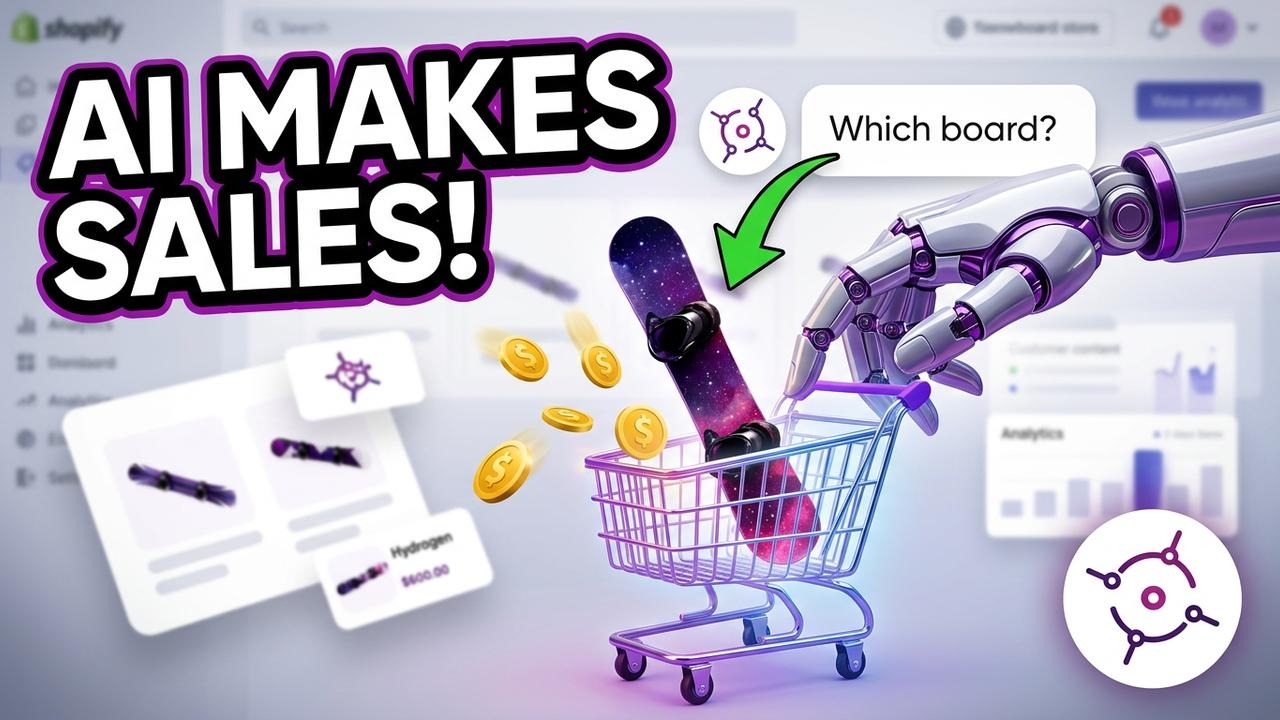
1. Help Customers Find the Right Products
Large product catalogs create choice, but they can also create confusion. A customer doesn’t necessarily want to browse hundreds of product pages. They may simply want to know which product is best for what they need.
An AI shopping assistant can help narrow available options based on the customer’s requirements. A shopper might ask, “I need a gift under $75 for someone who loves running.” Instead of forcing that customer to search multiple categories, an AI chatbot can potentially identify relevant products and guide them toward suitable options. This changes product discovery from “Find the correct category yourself” to “Tell us what you need.”
2. Answer Product Questions Instantly
Product uncertainty is one of the biggest sources of friction in ecommerce. Customers cannot physically inspect, test, or compare products in the same way they can inside a store.
An AI chatbot can help shoppers quickly find answers about product specifications, ingredients, materials, sizes, compatibility, features, product differences, usage instructions, availability, shipping, and returns. The objective isn’t to overwhelm customers with more information. It is to deliver the right information at exactly the right moment.
3. Provide Personalized Product Recommendations
Traditional ecommerce search is largely built around keywords, but customers don’t always think in keywords. Someone buying skincare may understand their concern without knowing which ingredient or product category they need. Someone purchasing electronics may understand the problem without knowing the technical specification required to solve it.
Conversational AI allows customers to begin with the problem. A traveler might say, “I need headphones that are comfortable for long flights.” The assistant can ask whether they prefer earbuds or over-ear headphones, whether active noise cancellation matters, and what their budget is. Now the chatbot isn’t simply searching a product database. It is helping the shopper make a decision.
4. Capture Leads Before Visitors Leave
Not every visitor is ready to purchase during the first session, but that doesn’t mean the visitor has no value. An AI chatbot can create opportunities to turn anonymous website traffic into future customers.
If a shopper asks about an unavailable product, the conversation can offer to notify them when it returns. With appropriate consent, a lost shopping session can become a future sales opportunity. Conversational experiences can therefore support lead generation as well as immediate sales.
5. Reduce Purchase Friction
Every unnecessary step in ecommerce creates another opportunity for abandonment: searching, navigating, filtering, comparing, finding shipping information, finding return policies, contacting support, and waiting for a response.
Conversational AI can potentially compress several of these steps into a single interaction. Instead of Homepage → Menu → Category → Product → FAQ → Shipping Policy, a shopper may simply ask, “Can this arrive before Friday?” Less searching. More answering. The easier it becomes for qualified shoppers to get the information they need, the smoother the path toward checkout can become.
6. Provide 24/7 Customer Assistance
Online stores don’t close at 5 p.m. Customers may arrive through Google, Meta, Instagram, TikTok, YouTube, email, or direct traffic at any hour. Maintaining human customer support around the clock can be expensive.
AI chatbots can provide immediate automated assistance for many common questions regardless of when a visitor reaches the website. That doesn’t mean AI should eliminate human customer service—complex or unusual situations may still require human judgment. A more effective model is simple: AI handles repetitive questions and initial conversations; humans handle situations where human expertise and judgment provide greater value.
AI Chatbots Can Connect Advertising With Conversion
Most businesses treat advertising and website chat as separate systems. An advertisement generates a click, the visitor reaches the website, and then the advertising platform’s role effectively ends. But the customer’s journey isn’t over.
A stronger journey can look like Advertisement → Landing Page → Customer Question → AI Conversation → Product Recommendation → Purchase. The chatbot becomes part of the post-click conversion experience.
Improving advertising performance isn’t only about generating more traffic or cheaper clicks. It’s also about generating more value from the traffic you’re already paying to acquire. NeuroAds combines AI advertising, Shopify chatbot automation, and ecommerce performance strategy rather than treating each function as completely separate.
What Features Should an AI Chatbot Platform Have?
- Natural-Language Understanding — Customers should be able to communicate naturally without learning special commands or navigating rigid menus.
- Product Knowledge — An ecommerce chatbot should understand relevant information about the products being sold.
- Product Recommendations — A powerful ecommerce chatbot should do more than answer FAQs; it should help customers discover products relevant to their needs.
- Ecommerce Integration — The chatbot should work naturally with the systems powering the online store rather than becoming another isolated piece of software.
- Lead Capture — With appropriate consent, valuable conversations can become future marketing opportunities.
- Analytics and Customer Insights — Repeated questions can reveal what customers do not understand, what product information is missing, and where friction exists.
- Human Handoff — Customers should have an appropriate path to human assistance when a conversation requires it.
- Easy Installation — Technology should reduce complexity, not create more of it.
How Do You Choose the Best AI Chatbot Platform?
Don’t choose a chatbot simply because it has the longest feature list. Start with a more important question: What business outcome are you trying to improve?
If your biggest problem is customer support, prioritize support automation. If your biggest problem is product discovery, prioritize recommendation capabilities. If you’re losing customers because they can’t find information, prioritize product knowledge and conversational search. If you’re spending heavily on advertising, examine how the chatbot fits into the complete customer journey after the click.
Then evaluate accuracy, relevance, integration, control, analytics, scalability, and customer experience. The best AI chatbot isn’t necessarily the one with the most features. It’s the one that creates the best customer experience and measurable business value.
Can AI Chatbots Improve Ecommerce Conversion Rates?
Consider an ecommerce store receiving 10,000 visitors. Some are browsing, some are researching, and some are comparing alternatives. Another group may be very close to purchasing and have just one unanswered question.
Conversational AI creates another point of engagement. The chatbot may answer an objection, recommend an appropriate product, explain differences, clarify shipping information, help customers locate information, capture a qualified lead, or guide a shopper toward the next step.
Not every chatbot conversation will generate a sale, and businesses should avoid assuming that adding AI automatically increases conversions. Conversion optimization is about systematically identifying and removing unnecessary obstacles that prevent qualified customers from taking action.
Will AI Chatbots Replace Human Customer Service?
AI chatbots aren’t necessarily about replacing people. A better customer experience can combine the scalability and availability of AI with human judgment and expertise.
AI is particularly useful for repetitive, information-driven interactions. Humans remain important when situations are complicated, unusual, sensitive, or require discretion. Think of an AI chatbot as the first available assistant, not necessarily the last point of contact a customer will ever need.
The Future of Ecommerce Is Becoming Conversational
For years, ecommerce websites have required customers to adapt to websites. Customers learned where menus were located, how filters worked, where FAQs lived, and how to navigate large product catalogs.
Conversational AI begins to reverse that relationship. Instead of customers having to understand how a website organizes information, the website can increasingly understand what the customer is asking. The traditional ecommerce experience looks like Search → Browse → Filter → Compare → Decide. Conversational commerce can increasingly look like Ask → Discover → Decide → Buy.
How NeuroAds Approaches AI Chatbots
At NeuroAds, the idea is straightforward: getting the click is only the beginning. An ecommerce business can run effective advertising and still lose potential revenue when visitors become confused, hesitate, or cannot find the information they need after reaching the website. That’s why NeuroAds connects AI advertising, Shopify chatbot automation, and ecommerce performance strategy as parts of the broader customer journey.
The goal isn’t simply to place another chat bubble on a website. The goal is to create useful conversations that help customers move forward: answer the question, help discover the product, reduce uncertainty, capture the opportunity, continue the customer journey, and—when appropriate—help move the shopper closer to conversion. Explore the NeuroAds AI Chatbot to see how it works.
Ready to add AI-powered conversations to your store?
You’re already investing to bring people to your site—the bigger question is what happens after they arrive. Answer the question, remove the hesitation, recommend the right product, capture the lead, and continue the conversation. Free plan, installs in about a minute, no code.
Add to Shopify — free